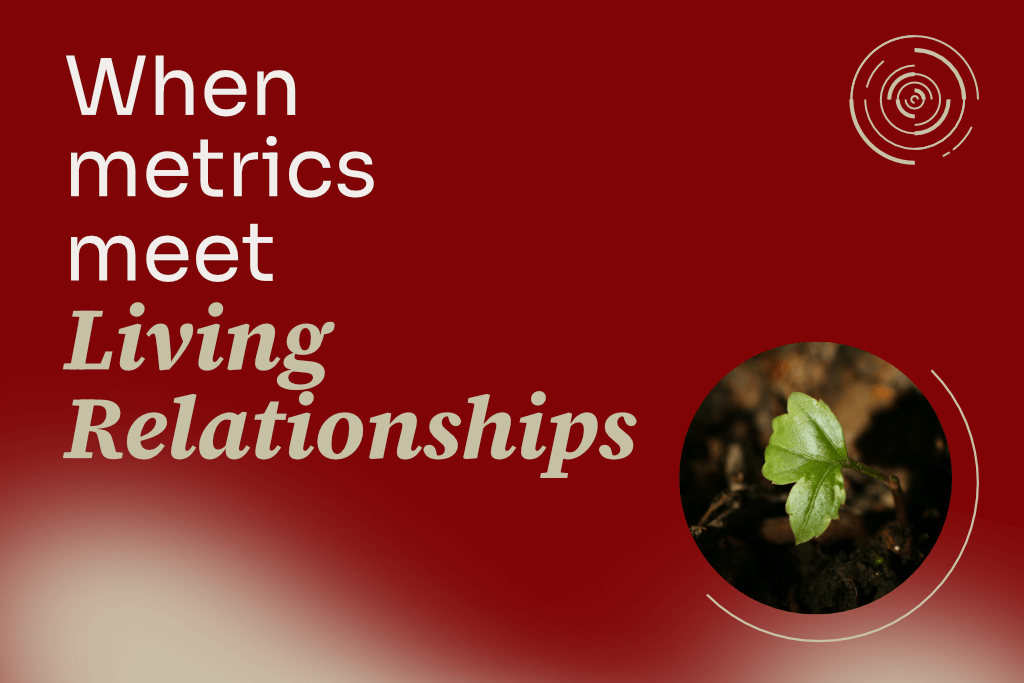
If there is one thing we have learned over the past few years following organizations and impact projects, it’s that not everything that matters can be measured with numbers, and not everything that can be counted truly counts.
This provocation became central to rethinking how we evaluate the impact generated by socio-environmental actions.
Impact evaluation, in its essence, is a tool to understand if, how, and why our actions generate relevant changes.
But when we are guided exclusively by numerical metrics or linear logic, we run the risk of losing sight of the living complexity of the systems in which we operate and reducing people to statistics.
Therefore, we believe that measuring impact is not merely a technical issue: it is also a political, ethical, and, above all, relational choice.
Why do we need to talk about impact evaluation?
Evaluating a project’s impact is not about proving external value—although that is also important—but it is, above all, a process of learning and accountability.
Learning that allows us to honestly observe what is working (or not), what paths we are taking, and what needs to be adjusted or deepened. Accountability because it commits us to those impacted, to the resources mobilized, and to the ecosystem in which we operate.
In a world where problems are complex, interconnected, and non-linearly causal, thinking about impact requires more than measuring outputs.
It is not enough to know how many people participated in a training, for example; it is necessary to understand if there was a transformation, if something was mobilized, if relationships were altered, and if new possibilities emerged.
As Daniel Christian Wahl reminds us, working in living systems requires abandoning the illusion of control to make room for flow, adaptability, and care for the effects that ripple in multiple directions.
This means that evaluating is listening to the system.
What if evaluating was also regenerating?
By bringing the regenerative perspective to evaluation, what is at stake is a paradigm shift:
Measuring to prove ➔ Measuring to understand and nurture.
The regenerative approach invites us to look at projects and organizations as living organisms, embedded in specific contexts, with complex relationships and unique potential for transformation.
Here, the role of evaluation expands. It stops being a final exercise, almost like a project check-out, and becomes a continuous tool for learning, listening, and guidance.
A regenerative evaluation, therefore, is not limited to predefined indicators; it transforms with the project, with its participants, with the territory, and with time. It is alive, like everything that seeks to regenerate.
Carol Sanford proposes that organizations can operate at different levels of depth: operational, strategic, systemic, and evolutionary. These levels also help us reflect on what we are measuring.
Are we evaluating only the project’s operational efficiency? Or are we also able to capture the effects it generates on culture, on relational patterns, and on the system’s capacity to self-transform?
For us, it is necessary to go beyond the surface and also evaluate what is not immediately visible, but is essential.
Between numbers and narratives: possible paths
At We.Flow, we seek to integrate both worlds: the rigor of evaluative methodologies with the sensitivity of someone who recognizes that real impact often reveals itself in details, bonds, and stories.
To achieve this, we combine quantitative instruments with qualitative methods that help us dive into the lived experiences of those participating in the projects.
We are talking here about active and empathetic listening. Listening carefully means going beyond what is said, perceiving the context, the silences, the assigned meanings. It means understanding that data is not neutral, and that what often looks like a numerical “failure” can contain a rich story of transformation invisible to the eyes of a spreadsheet.
That is why we incorporate Nora Bateson’s concept of “warm data” into our practice.
Unlike “cold” data, which isolates variables and simplifies relationships, warm data captures the in-between: the connections, the contexts, the multiple meanings that emerge from a real situation.
Collecting warm data is creating safe spaces for meaningful conversations; it is letting go of neutrality to embrace complexity.
In our evaluative processes, this translates into dialogue circles, narrative records, reflective workshops, and instruments that respect the time and way each person tells their own story.
Coherence between purpose and evaluation
If we say we work for regeneration, we cannot apply an evaluative logic that contradicts this value.
This means reviewing our questions, our instruments, and our feedback formats. It also means including the voices of those rarely heard in evaluation processes: directly impacted people, community leaders, partner organizations.
Regenerative practice demands deep listening to local realities, and therefore we adapt tools like the Logical Framework so they are understandable, useful, and appropriate to the contexts we work with.
The same happens with the Theory of Change: for us, it is not a pretty infographic, but a collective process of alignment, co-creation, and future vision, where each actor involved contributes their perspective on root causes, necessary conditions, and possibilities for transformation.
Here, Wahl’s ideas echo once again: it is not about designing solutions for people, but with them, from a deep listening to the living and relational patterns of each system.
By looking at the theory of change as an evolutionary process – and not as a fixed map – we leave room for adaptability, for the unknown, and for the emergence of more powerful paths than those anticipated.
Accountability with rigor and sensitivity
A common question we hear is: “how do we present qualitative data to investors and partners?”.
Our answer is simple: with the same seriousness and clarity with which we present charts.
Stories, testimonials, learnings, and even the challenges faced have communicative and strategic value. When properly contextualized, they do not diminish a project’s credibility; on the contrary, they increase its depth and authenticity.
Narratives are powerful because they connect, inspire, and translate what numbers cannot. When used well, they do not replace data, but complete it.
In our reports, we always strive for this balance: objective indicators that show results, and narratives that give body and soul to those numbers. Thus, accountability becomes more than a transparency exercise; it becomes an invitation to co-responsibility.
Furthermore, including qualitative data in a structured way – as we do with techniques inspired by Warm Data Labs – allows partners to see what is really transforming, even when the results are not yet measurable on a large scale.
This is especially true for projects aimed at strengthening communities, cultural changes, or long-term educational processes. The impact is there, but it needs to be read through a different lens.
Evaluation as part of the change, not as a final judgment
The regenerative perspective reminds us that evaluating is not an end; it is part of the journey.
When done carefully, evaluation becomes a way to nurture the very transformation we wish to promote. It feeds back into the process, expands the team’s awareness, and strengthens the relationship with the territories.
More than measuring whether the project “worked”, we ask: how was it felt? What transformed in those who participated? What new seeds were planted?
These questions guide us in search of an impact that is not merely declarative, but experienced and recognized by those at the center of the action.
This is also an evolutionary movement, as proposed by Carol Sanford. Truly transformative projects don’t just reach goals; they strengthen the evolutionary capacity of the systems in which they operate.
Evaluating through this lens means looking not only at immediate results but at long-term effects, including those that are still germinating. It is recognizing that impact is also potential, and that part of our role is to create the conditions for it to flourish.
What we use to measure with more meaning
To ensure that our evaluations honor these principles, we adopt some fundamental practices:
- Immersive diagnostics, combining documentary analysis, open conversations, and deep listening to the different actors involved.
- Co-created theories of change, with in-person and online stages, which value local knowledge and the relationships between causes and effects.
- Mixed instruments, combining quantitative indicators with qualitative techniques (interviews, focus groups, life stories, participant observation).
- Feedback systems designed not as final reports, but as living learning materials for organizations and their stakeholders.
- Iterative processes, that follow the project cycle and allow for route adjustments as data (and reality) evolve.
These practices, anchored in active listening, empathy, and systemic awareness, help us create evaluations that are simultaneously deep and applicable, technical and sensitive, structured and open to the new.
Towards a new impact culture
We believe the future of evaluation lies in the ability to integrate rigor and soul. It is not about abandoning numbers, but complementing them with what truly moves us: relationships, learning, and paradigm shifts.
Projects that call themselves regenerative cannot measure their impact through extractive lenses. They need to evaluate with the same quality of presence, listening, and intention with which they operate.
And this is possible; more and more organizations are seeking evaluation models consistent with the futures they wish to build.
At We.Flow, we follow this path with humility, learning from every project, every territory, and every partnership. We know that evaluating is not an easy task, but it is essential.
Because only by recognizing what we are generating, and how we are doing it, can we move towards an impact that not only transforms but also regenerates.
The construction of this article was based on concepts and guidelines of impact evaluation and regenerative development found in:
- Sanford, C. (2017). The Regenerative Business. Nicholas Brealey Publishing.
- Wahl, D. C. (2016). Designing Regenerative Cultures. Triarchy Press.
- Bateson, N. (2017). Small Arcs of Larger Circles: Framing through other patterns. Triarchy Press.
- IDIS – Instituto para o Desenvolvimento do Investimento Social. (2023). Avaliação de Impacto: conceitos e métodos.
- Social Value UK (2022). SROI Guide.